Robyn’s Ultralight Backpacking Kefir Breakfast
Delicious, nutritious and packed with probiotics, milk kefir makes a lightweight and healthy breakfast on trail

A yummy brekky on the Kangaroo Island Wilderness Trail
What is Kefir?
Originating in Eastern Europe, milk kefir is a delicious food made by fermenting milk, somewhat like an extra tangy yoghurt but with different and far richer microflora. The gelatinous ‘grains’ are a scoby — symbiotic colonies of yeast and bacteria in a protein- and enzyme-rich gel — and, because kefir ferments best at room temperature (18C-25C / 65F-85F), ie lower temperatures than does yoghurt, it is much easier to keep actively growing on trail in Australia and other mild temperate to tropical climates. Mixed with seeds and berries, this kefir recipe makes a powerhouse keto breakfast, or add granola for carbs.
Kefir’s probiotics are fantastic for human gut health so, if you’re someone who often experiences tummy upsets or bowel irregularities on trail, fermented food can be game-changing. Of course, acclimate your digestion at home first! Even those with lactose sensitivities may be able to tolerate milk kefir because most of the lactose is consumed during the ferment.
When you’re thru-hiking for weeks or months on end, kefir is excellent for long-term digestive health and, with the exception of the scoby itself, all ingredients are shelf-stable and compact: ideal for resupply boxes, or buy them in track towns.
Kefir ferments to a smoothie texture rather than a solid like yoghurt, but in this recipe the addition of chia seeds creates a thicker, more conventional breakfast texture.
Can I eat the kefir grains if I have too many?
Absolutely yes: although the strong flavour is not to everyone’s taste, this scoby is highly nutritious and an even more concentrated source of probiotics. Of course, don’t deplete your necessary starter: keep plenty in reserve. If, over a long trip, you start to accumulate more grains than you need, just return some to your strained milk with the seeds before eating.
Kefir on The Trail
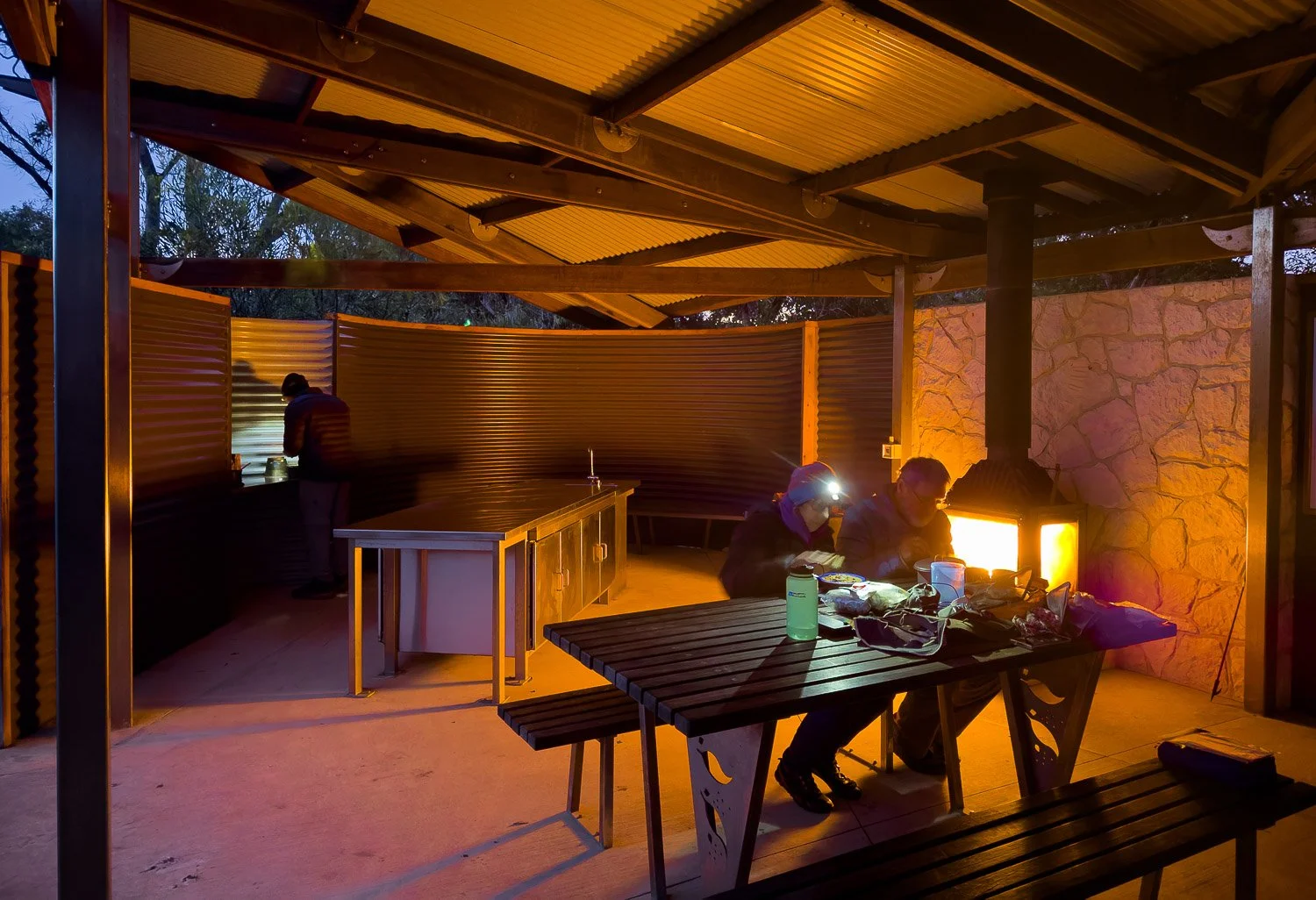
Robyn and David enjoy a home-made rehydrated dinner on the Kangaroo Island Wilderness Trail.
We met Robyn and David on the Kangaroo Island Wilderness Trail and were fascinated by Robyn’s clever adaptations to make this healthy breakfast lightweight and practical for backpacking. Using dehydrated berries and seeds, full cream milk powder, and lightweight containers and sieve, she prepared this minimal fuss keto breakfast every day.
In fact, it’s perfect for leisurely hikers. Mix the milk and kefir grains when you arrive in camp and then, the following morning, sieve out the grains, add the seeds and berries to the kefir milk, and pack up camp in the 25-30 minutes it takes to thicken. You can eat it sooner or even (drink it) immediately, it will just be runnier. It’s faster for couples: one prepares the kefir while the other starts packing up camp.
Robyn purchased her kefir grains in Australia here more than a decade ago and they are still going strong; they are available worldwide so google kefir grains in your region, or beg a starter from anyone you know who cultivates them.
Although Robyn’s keto recipe uses only seeds and berries, you could easily substitute (or add) your favourite granola for more carbs, and/or extra seeds or even protein powder.
Ingredients for ONE serve:
Excluding water and the single 15g/0.53oz kefir grains carried over multiple days, one serve dry weight is 110g-117g (3.9-4.2oz), with approximately 440 cal/1805kJ and 15.4 g/0.53oz of protein. Length of fermentation and scoby vigour affect protein and calorie content.
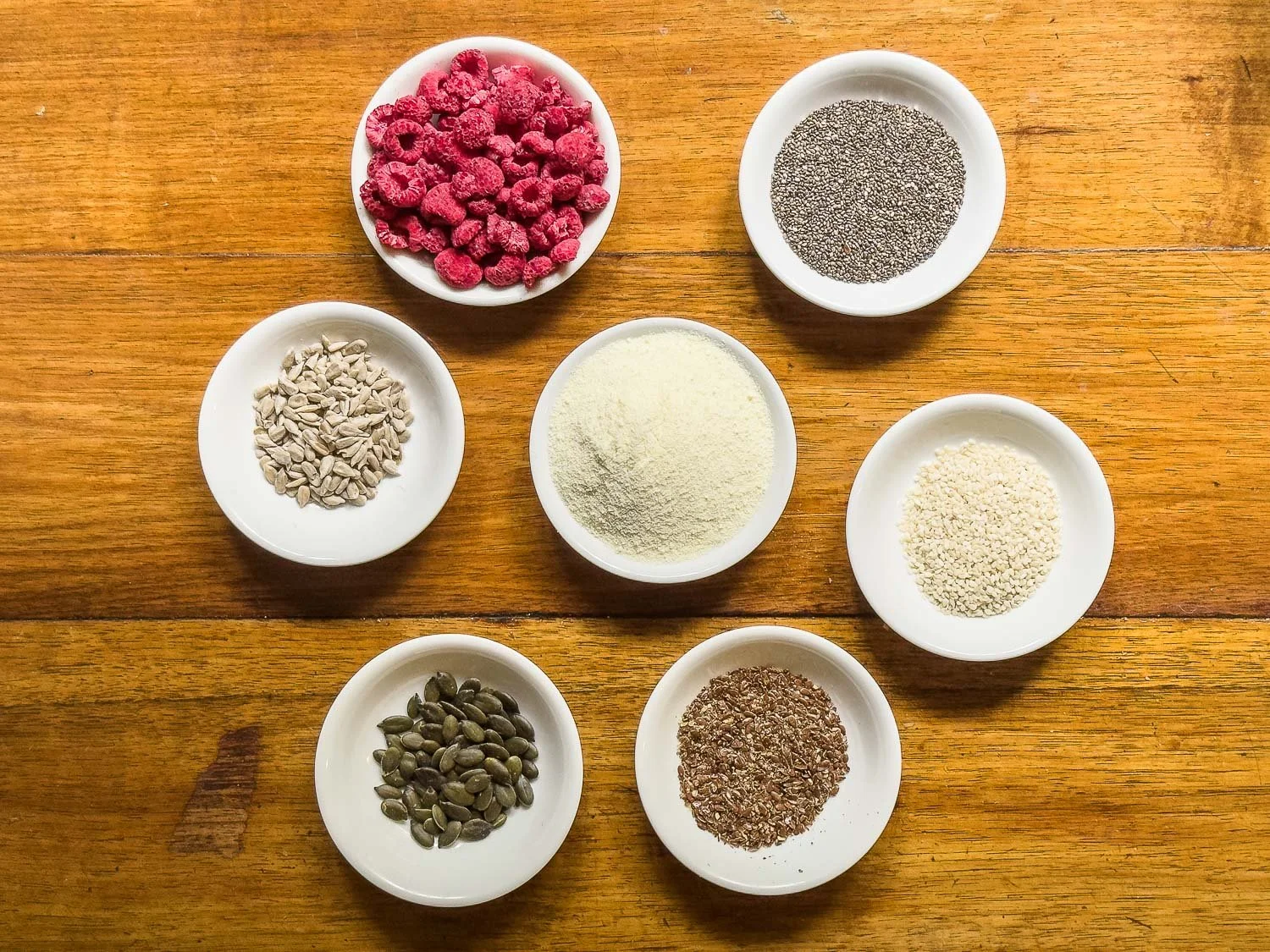
Ingredients excluding kefir grains clockwise from top left for 1 serve: freeze dried or dehydrated berries, chia seeds, sesame seeds, processed linseed, pumpkin seeds, sunflower seeds. Centre: full fat milk powder.
10-12g (0.35- 0.42oz) dehydrated raspberries and/or strawberries*
40-45g (1.4-1.6oz) full fat milk powder**
1 tbspn kefir grains, approximately 15g (0.53oz)*** in a double-bagged ziploc or small resealable, reusable mylar pouch
Water to make up 250ml (8.45 fl oz) milk (use potable, filtered, or boiled and cooled water, but not water that has been treated with purification tablets or drops as these inhibit fermentation)
60g (2.1oz) Seed Mix comprising***
20g (0.7oz) chia seeds
10g (0.35oz) pumpkin seeds
10g (0.35oz) sunflower seeds
10g (0.35oz) sesame seeds (raw or toasted)
10g (0.35oz) linseed, lightly processed (broken but not powdered)
*Halve and slightly flatten fresh or frozen raspberries on dehydrator trays before drying. Slice strawberries 5mm thick and dehydrate, or use freeze-dried berries, which rehydrate almost instantly. Substitute with any palatable dried/dehydrated chopped fruit or freeze-dried berries.
**Extra milk powder produces a creamier consistency and provides extra calories
***Recipes for kefir usually recommend one teaspoon (5g/0.18oz) of grains, but on trail they work faster if you use more; younger grains can take 24 hours or longer when you first start fermenting them. In any case, because they multiply, you end up with more over time, so each day you add more kefir grains to the milk. For example, Robyn had about 100g/3.5oz on the KI hike because that was what she was carrying by the end of a long road trip. Other times she starts with about 1 tbspn per person (approx 15g/0.53oz) per serve.
If doubling the recipe for two people you double the kefir grains along with other ingredients. If you’re packaging for ten days, you multiply other ingredients but don’t need extra kefir because you reuse it every day.
**** Almost any seed mix is suitable, but chia seeds are important for a thicker consistency.
Equipment
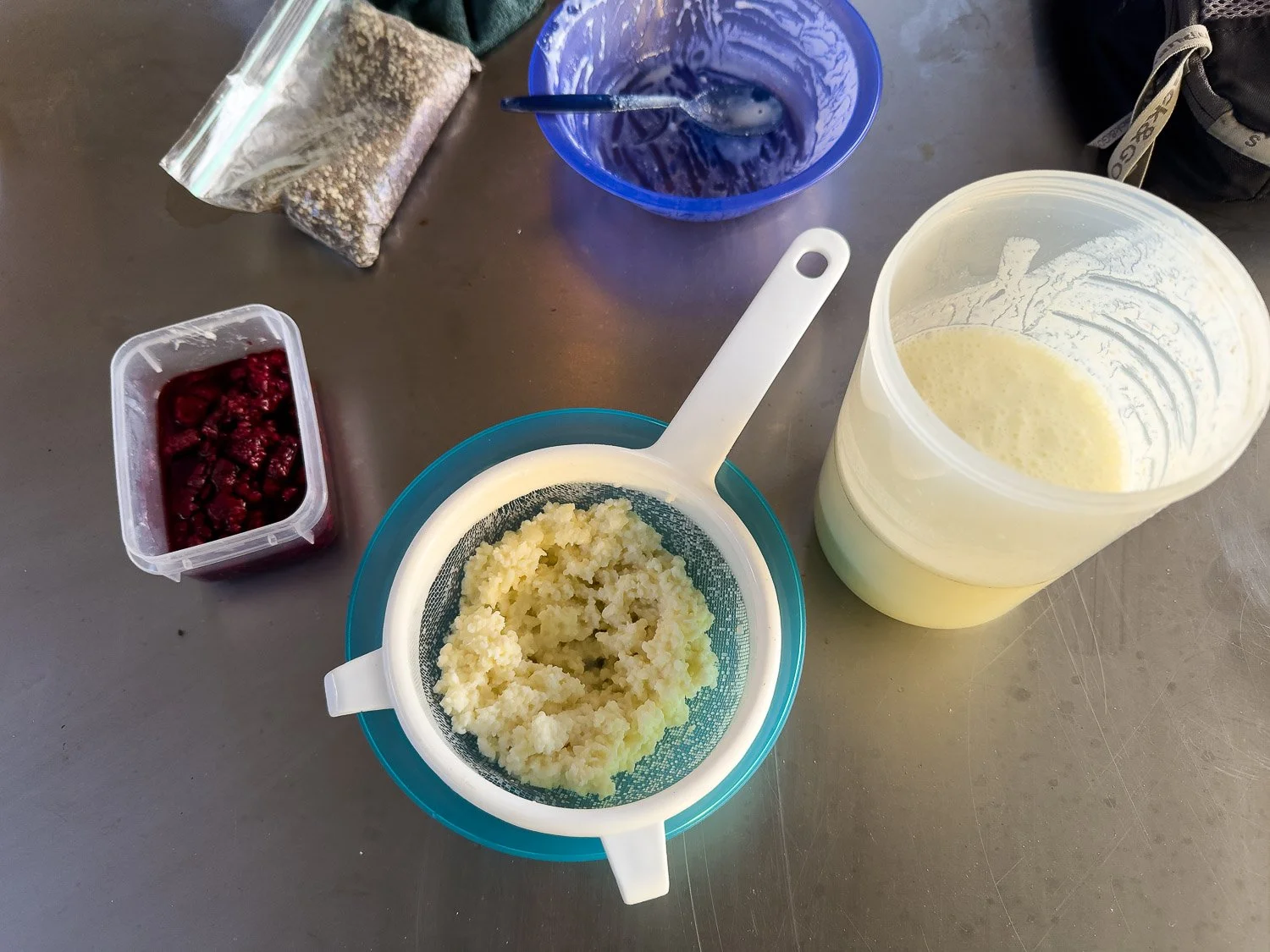
Clockwise from top left: Seed mix (for two), bowl used for straining, kefir milk in screwtop jar, sieved kefir grains, rehydrated berries in sealable container (or use a ziploc or reusable mylar bag). Here, Robyn makes up two serves in a 1L container with 2 bowls for herself and David.
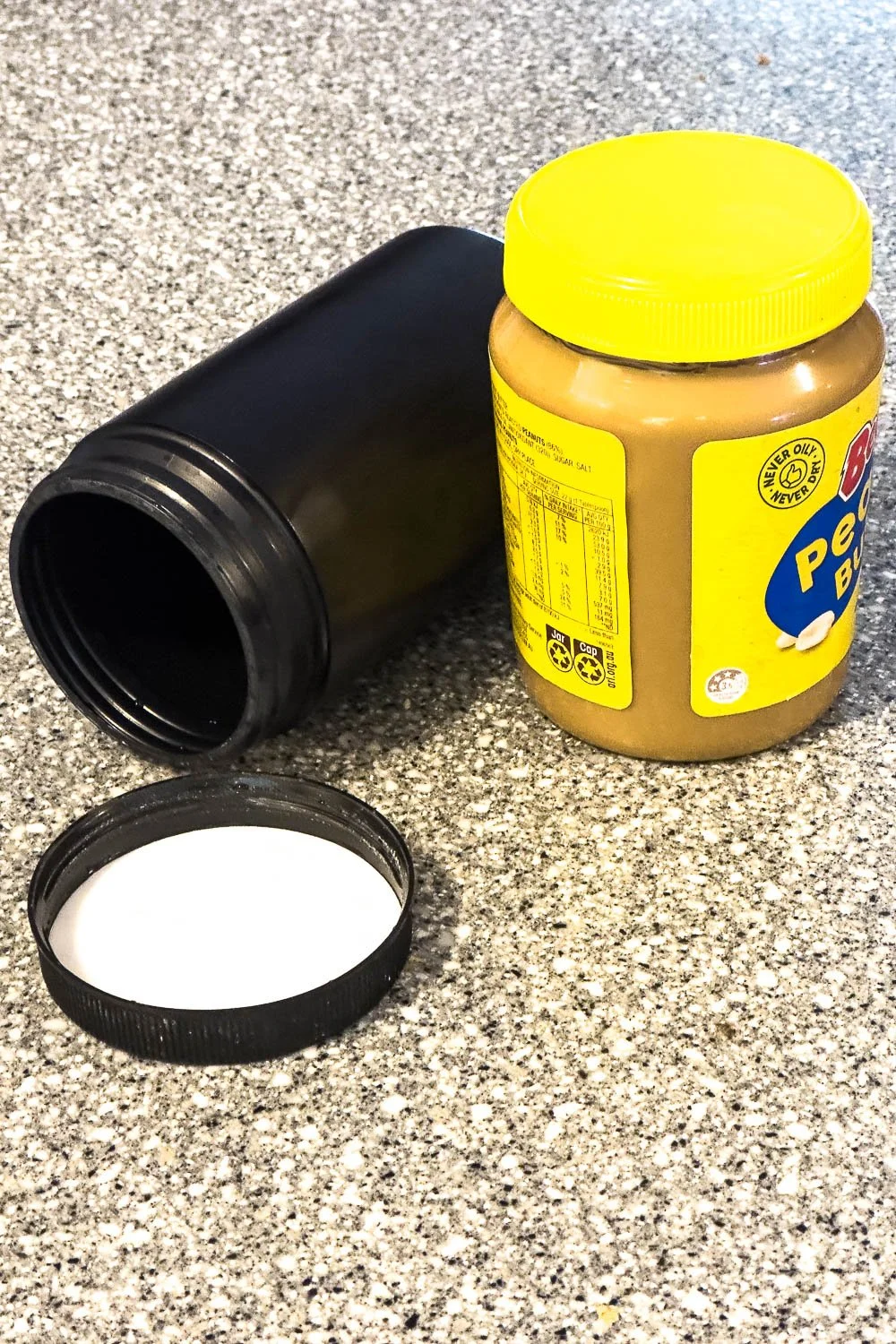
Suitable plastic screw top jars.
Left: 800ml/27.1 fl oz recycled supplement jar, 66g/2.3oz.
Right: 560ml/19fl oz Peanut butter jar, 48g/1.7oz.
1 large resealable mylar bag for seed mix, or package each day’s serve into a ziploc*
500ml screw top plastic jar (800ml-1L jar for two)
Small re-useable, re-sealable mylar or silicone bag, or ziploc for rehydrating berries
Small re-useable, re-sealable mylar or silicone bag, or double ziploc for kefir grains
Small plastic sieve (illustrated is 60g/2.1oz, but Robyn now uses a 10g/0.35oz nylon one as found on Amazon, Temu etc)
Camping spoon
Bowl or mug with a larger diameter than your sieve
*Alternatively, estimate your 60g/2.1oz of seeds and 40g/4.1oz milk powder by calculating the requisite number of camp spoonfuls at home, or by adding seeds or powder to a marked camp cup; this reduces plastic. If doing this, mix seeds thoroughly before scooping them out.
Method:
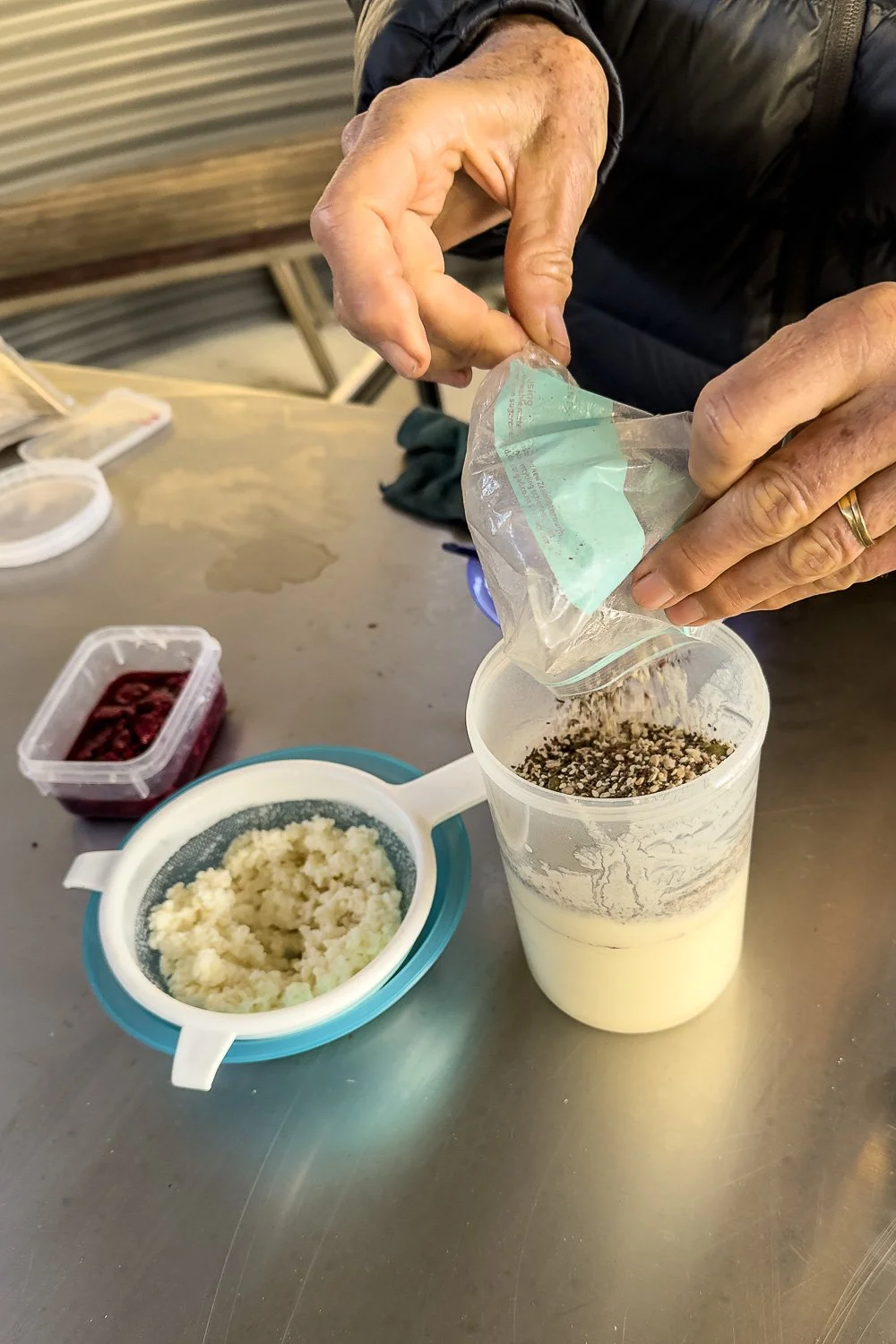
Adding seed mix to kefir milk
Upon reaching camp, mix milk powder with water in the screw top container to make 250ml/8.5fl oz milk.
Add kefir grains, rinsing the ziploc with a small amount of water to extract the last grains, and stir them through the milk. Replace lid loosely to allow gas to escape.
Place jar upright in tent vestibule (beware possums!) or in your pack overnight, inside your tent if it’s cold.
Place berries into a ziploc or container, add water to generously cover, and reseal to rehydrate overnight (or do this in the morning if using freeze-dried berries).
In the morning, strain grains from milk over your bowl or mug using a spoon to gently stir grains in the sieve. Return grains to their ziploc.
Add seeds and berries to kefir milk in the bowl or mug to soak. If making two serves, return the kefir milk to the fermenting container and add the seeds and berries to soak there, before decanting into two bowls. The longer you soak seeds the more the mix thickens; 30 minutes suits Robyn.
Enjoy your Breakfast!
Wash screw top jar, place bag of kefir grains inside, and screw on lid for transport in your pack for the day.
Thank you Robyn and David for your company and for generously sharing your recipe technique with other hikers!
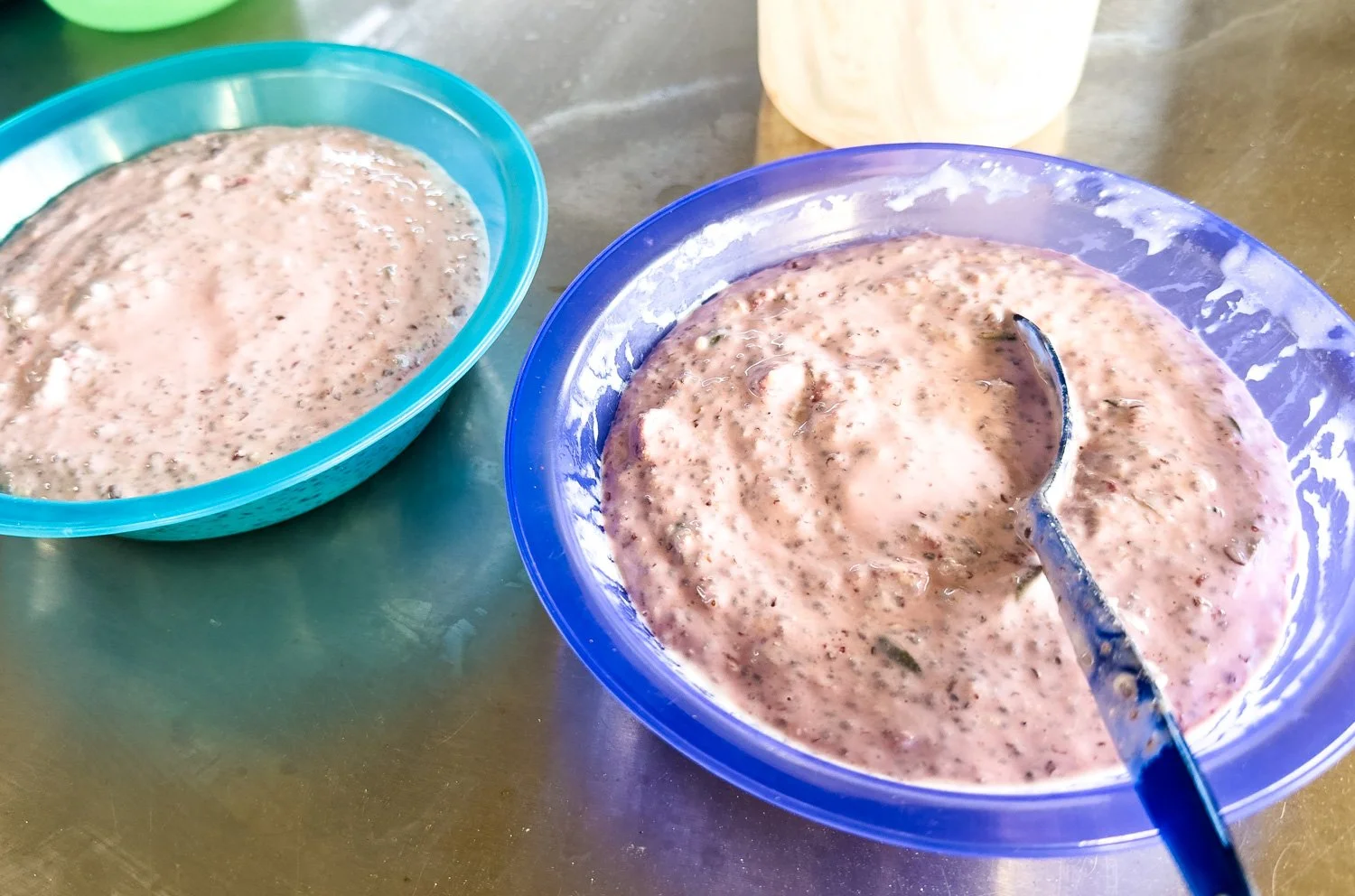
Yum!